Paying $2,100 in Rent? Could You Buy a Home Instead?
Let’s follow the money. It might be more interesting than you think.
Could $2,100 in rent become a home of your own?
Possibly. A $2,100 monthly rent payment may put homeownership within reach, but it does not mean you can comfortably afford a $2,100 mortgage payment. Down payment, interest rate, property taxes, insurance, mortgage insurance, maintenance and savings all matter.
Let's compare the numbers for a hypothetical Northeast Tennessee buyer—without pretending the water heater will last forever.
Every month, you pay the rent.
Maybe it's $1,500. Maybe it's $2,100. Maybe it's an amount that makes you wonder whether your apartment comes with a small ownership interest in the building.
And sooner or later, a question probably crosses your mind:
“If I'm paying this much every month, why couldn't I just buy a house?”
That's a perfectly reasonable question.
But before we start shopping for houses, there's another question worth answering:
What does it actually cost to own one?
Because, as anyone who has ever owned a home knows, the mortgage payment is only the beginning of the adventure.
What Expenses Does Your Rent Actually Cover?
It's tempting to imagine your landlord depositing your rent check, putting their feet up, and planning their next vacation.
Some landlords might do that. But first, they have bills to pay.
Mortgage payments. Property taxes. Insurance. Maintenance. Repairs. And occasionally the unpleasant discovery that the last tenant's definition of “normal wear and tear” was remarkably creative.
Let's imagine a landlord collecting $2,100 per month.
| Monthly expense | Amount |
|---|---|
| Mortgage | $1,200 |
| Taxes and insurance | $300 |
| Maintenance reserve | $150 |
| Vacancy reserve | $100 |
| Property management | $150 |
| Total estimated expenses | $1,900 |
| Money remaining | $200 |
Two hundred dollars a month.
Not exactly a private-island budget.
And that remaining money isn't necessarily pure profit. There may be additional expenses, unexpected repairs, and an investment the landlord expects to earn a return on.
Here's another wrinkle.
The landlord can't simply charge whatever they need.
If similar homes rent for $1,900, asking $2,100 because the numbers work better on a spreadsheet probably won't persuade many tenants.
Sometimes landlords accept smaller returns. Sometimes they absorb losses. And sometimes maintenance gets postponed.
Unfortunately, a leaking faucet doesn't generally repair itself while everyone waits for interest rates to improve.
Can You Buy a House With a $2,100 Monthly Budget?
Possibly—but a $2,100 mortgage payment is not the same thing as a $2,100 monthly housing budget. Property taxes, homeowners insurance, maintenance, and sometimes mortgage insurance must be included.
Instead of comparing partial payments, let’s look at a single example that includes the major ongoing costs of ownership.
What Does a $2,100 Housing Budget Mean in Northeast Tennessee?
A home with the same asking price can have a different monthly cost depending on where it sits. For example, compare a property inside Johnson City limits with one outside city limits in Washington County: applicable property taxes may differ. Kingsport and Bristol buyers should also verify the specific municipality and county rather than assuming every address has the same tax bill.
Property condition matters just as much. In Northeast Tennessee, a buyer may need to budget for a roof or HVAC replacement, crawlspace moisture or drainage work, and—where applicable—septic maintenance. Those are not costs a lender's principal-and-interest quote will capture.
Financing options also differ. Depending on the buyer and property, conventional, FHA, VA or USDA financing may be worth discussing with a licensed lender. Down payments, mortgage insurance, eligibility and total costs are not identical across programs.
Local examples are illustrative; no current MLS listings or property-specific tax bills are represented here.
What Would a $260,000 Home Really Cost Each Month?
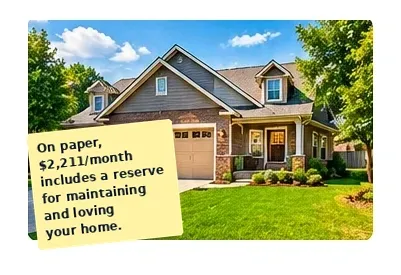
Let’s buy a $260,000 house. On paper, anyway.
Suppose you purchase a $260,000 home with a 5% down payment.
Plus the ongoing costs of maintaining and loving your home.
| Expense | Monthly cost |
|---|---|
| Mortgage principal and interest | $1,561 |
| Property taxes | $175 |
| Homeowners insurance | $150 |
| Mortgage insurance (if required) | $125 |
| Maintenance reserve | $200 |
| Estimated monthly ownership cost | $2,211 |
Illustrative example: $260,000 purchase, 5% down ($13,000), 30-year mortgage at 6.5%. Figures are rounded; mortgage insurance depends on loan terms. Utilities, HOA fees and upfront closing costs are not included.
Compared with $2,100 in monthly rent, this example estimates $2,211 in monthly ownership costs—about $111 more, before any differences in utilities or HOA fees.
Well, look at that.
Except we haven't finished.
First, you'll need approximately $13,000 for the down payment, plus closing costs.
Then there's maintenance.
The furnace doesn't know you just spent your savings on a down payment. The refrigerator has no interest in your financial goals. And the water heater seems particularly fond of breaking down when you have company coming for Thanksgiving.
As a homeowner, you are now the person who gets the repair bill.
On the other hand, part of your mortgage payment reduces your loan balance, potentially helping you build equity over time.
That's something rent doesn't do.
But equity isn't guaranteed profit. Property values can fall, and selling a home comes with expenses.
So is buying cheaper?
Not necessarily. But it might be worth investigating.
When Is Renting Better Than Buying?
Let's give renting the credit it deserves.
If you're planning to move in two years, buying may not make financial sense.
If purchasing a home would leave your savings account looking like the last slice of pizza at a family reunion, you might want to wait.
And if your idea of a relaxing Saturday doesn't include cleaning gutters, mowing grass, or discovering why the dishwasher is making that noise, renting has its advantages.
There is nothing wrong with renting.
In fact, buying the wrong house at the wrong price can be considerably more expensive than paying rent.
When Does Buying a Home Make Financial Sense?
Now things get interesting.
Suppose you expect to remain in Northeast Tennessee for the next several years.
Your income is reasonably stable. You've saved some money. You're comfortable with the responsibilities of homeownership.
Suddenly, buying may deserve a closer look.
A fixed-rate mortgage generally keeps principal and interest predictable, although property taxes and insurance can increase.
You may gain more control over your home. Want to paint the living room blue? Go ahead.
Want to install a garden? Plant away.
Want to replace the carpet with hardwood flooring? That's your decision.
Of course, you also get to pay for all those improvements.
Homeownership offers freedom. It just doesn't always offer free shipping.
Why Get Mortgage Pre-Approval Before House Hunting?
Here's another interesting distinction.
The amount a lender is willing to loan you and the amount you should comfortably spend aren't necessarily the same.
Lenders evaluate your income, debts, credit history, and available funds to determine financing eligibility.
A mortgage pre-approval can help you understand what's realistic before you start shopping.
And remember, just because you're approved to borrow a certain amount doesn't mean you have to spend every dollar.
The lender won't be paying your electric bill or buying your groceries.
Seven Questions Worth Asking Before You Decide
Before deciding whether to rent or buy, ask yourself:
- What am I really paying each month for housing, including utilities and other expenses?
- How long do I expect to live in the area?
- How much savings would I have left after buying?
- What monthly payment would still feel comfortable if other expenses increased?
- What financing options might be available?
- What are the actual taxes, insurance costs, and likely maintenance needs?
- How important are flexibility, stability, control, and building equity to me?
You don't need to answer every question today.
But they're worth answering before making one of the largest financial decisions of your life.
So, Should You Keep Renting or Buy a Home?
You may have heard the expression that renting is throwing money away.
I don't agree.
Rent provides a place to live, flexibility, and freedom from many of the responsibilities of ownership. Those things have value.
Buying can also provide value through stability, control, and the opportunity to build equity.
And unlike the weather forecast, those numbers are something we can actually examine.
Curious What Your Numbers Would Look Like?
If you're renting in Northeast Tennessee and wondering whether buying might make sense, I'd be happy to help you explore the possibilities.
Tell me approximately what you're paying in rent and what monthly housing budget feels comfortable.
We can start with a simple comparison. No credit check, no obligation, and no pressure to buy.
You might discover that you're ready to explore homeownership.
Or you might discover that continuing to rent is the better decision.
Either way, you'll know more than you did before.
And that's a pretty good return on a few minutes of reading.
Tim Meyer
Real Broker
timmeyerrealtor.com
Tim Meyer · Real Broker
Tim Meyer is a real estate agent serving Johnson City, Jonesborough, Kingsport, Bristol and surrounding Northeast Tennessee communities. After a career in engineering, he brings an analytical, facts-before-decisions approach to helping buyers compare homes and understand the responsibilities and costs of ownership—without pressure.
Professional scope: Tim provides real estate guidance, not mortgage underwriting or individualized loan advice. Consult a licensed mortgage loan originator for financing eligibility, rates, loan products and pre-approval.
Financial examples are simplified illustrations, not current mortgage offers or guarantees of qualification. Actual rates, loan terms, and property expenses vary.
Categories
Recent Posts